
Industrial cafeteria or grocery vouchers: which fits your company
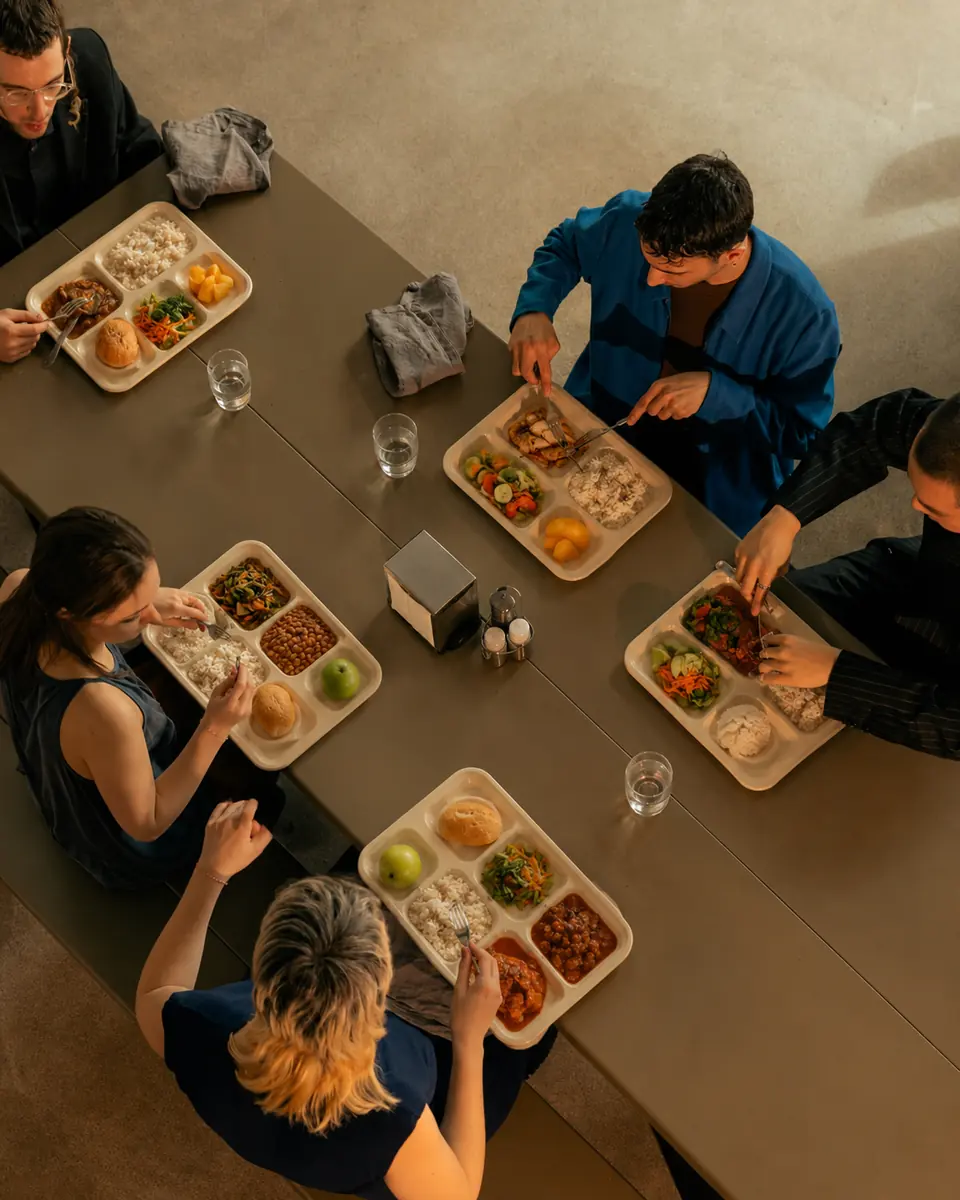
In the budget meeting, someone asks why the plant pays for a cafeteria when vouchers "are simpler and just as deductible." The short answer: choosing between an industrial cafeteria and grocery vouchers (vales de despensa) means deciding between two different benefits. The cafeteria takes care of the meal during the shift; the vouchers support household spending. And their treatment for taxes and social security contributions is not the same.
This content is for information only and is not tax or legal advice; consult your accountant or advisor before deciding.
No law requires you to have a cafeteria
It is worth starting here, because the opposite belief is widespread. The Ley Federal del Trabajo (Federal Labor Law) does not require employers in general to have a cafeteria or to provide meals. The meal obligations it contains apply to special categories of work, such as farm workers, ship crews, and domestic workers.
What is mandatory for your plant:
- Granting at least a half-hour break during a continuous workday (Article 63).
- Counting that time as time worked when the worker cannot leave the workplace (Article 64).
The cafeteria or the vouchers become mandatory only if you agreed to them in the collective bargaining agreement or in an individual employment contract.
What the Ley de Ayuda Alimentaria para los Trabajadores says
The Ley de Ayuda Alimentaria para los Trabajadores (Workers' Food Assistance Law), published in 2011, regulates both options. Three points matter:
It is voluntary. Article 3 says employers "may opt, voluntarily or by agreement," to grant food assistance. It is by agreement when it is written into the collective bargaining agreement.
It defines the forms it can take. Under Article 7, the assistance can be given as:
- Meals provided in cafeterias, restaurants, or other food establishments, contracted by the employer or through a voucher system administered by third parties.
- Groceries, in food baskets or in printed or electronic grocery vouchers.
It cannot be given in cash.
It does not create a tax benefit of its own. Article 13 states that the employer's expenses are deductible "under the terms and conditions" of the Ley del ISR (Income Tax Law; ISR is Mexico's income tax), and that the assistance is not part of the social security base under the terms of the applicable laws. In other words, it refers to other laws. That is where the rules actually are.
The law also requires that you be able to show the assistance was delivered (Article 10), and it sets a proper diet as the goal: complete, balanced, healthy, sufficient, varied, and adequate.
ISR: what is deductible and within what limits
The cafeteria
"The cafeteria is 100% deductible" is a phrase that gets repeated a lot and is missing half the story. Article 28, section XXI, of the Ley del ISR declares cafeteria expenses non-deductible in two cases:
- When the cafeteria is not available to all of the company's workers.
- When, even if it is, the expense exceeds a daily cap for each worker who uses it and for each day of service. The employee contribution (cuota de recuperación) is added to that cap.
The text of the law expresses that cap as one general daily minimum wage. In practice, accounting firms now calculate it with the UMA (Mexico's official reference unit for fees and limits), because of the de-indexation of the minimum wage. We know of no official criterion from the SAT (Mexico's tax authority) that settles it, and the difference between one reference and the other is large. That is why we do not give a figure here: ask your accountant for the current amount and the reference that applies.
The same section clarifies that the limit does not include related expenses, such as those for specialists who study the quality and suitability of the food.
On the worker's side, Article 94 of the same law provides that cafeteria and meal services provided to workers are not considered income in kind. Your people do not accrue income for eating at the plant.
Grocery vouchers
Vouchers come in as employee welfare benefits (previsión social). Article 27, section XI, requires that benefits be granted generally to all workers, and specifies that grocery vouchers are deductible only if they are delivered through electronic voucher cards authorized by the SAT.
There is a second filter. For the worker, vouchers are exempt income within the limits of Article 93. And Article 28, section XXX, limits the deduction of payments that are exempt income for the worker: the portion that results from applying the factor of 0.53 is not deductible, or 0.47 if the exempt benefits do not decrease compared with the prior fiscal year.
Whether or not that cut reaches the cafeteria is a matter of interpretation, and we know of no official criterion on it. Another reason not to sign off on the 100% phrase.
IVA
The cafeteria service a provider invoices to you is subject to IVA (VAT) at 16%. Article 2-A, section I, of the Ley del IVA (VAT Law) taxes food prepared for consumption at that rate, even though many basic ingredients are zero-rated.
That IVA is creditable if the expense is deductible for ISR and, when it is only partly deductible, in the same proportion (Article 5, section I). The IVA on whatever exceeds the cafeteria cap is not credited.
IMSS: when it counts toward the contribution base salary
The second belief worth correcting: "if the meal is free, nothing happens with IMSS" (the Mexican Social Security Institute). Something does happen.
Article 27 of the Ley del Seguro Social (Social Security Law) includes meals among the items that make up the contribution base salary (salario base de cotización). Its section V excludes them only when they are provided for a charge, that is, when the worker pays at least 20% of the daily reference set by the law for each meal.
If the meal costs the worker nothing, Article 32 applies: for each free meal, the salary is deemed increased by 8.33% for contribution purposes. The three meals add up to 25%.
That is where the employee contribution comes from. It has an effect on contributions and, as we saw, on the ISR cap.
Two cautions. The minimum amount of that employee contribution changes every year with the reference, so do not set it using a figure taken from the internet. And tax firms report that in July 2024 the IMSS Technical Council published a criterion on meals and housing, with requirements for delivery in kind, accounting records, and evidence of use. Ask your accountant to confirm the text of that resolution and how to document it.
Groceries have their own rule: section VI of the same Article 27 excludes them as long as their amount does not exceed 40% of the daily reference.
Cafeteria versus vouchers: the operational and the human side
| Criterion | Industrial cafeteria | Grocery vouchers |
|---|---|---|
| What the worker receives | A meal served during their shift | A balance to buy food for their home |
| Who benefits | The worker, at the plant | The family |
| The half-hour break | They eat on site; time in line is the critical point | Does not settle where or what they eat during the shift |
| Night shifts | Service can be provided on every shift | Does not change what is available in the early hours |
| Nutritional control | The menu is designed and can be audited | The company does not decide what is bought |
| Hygiene | The provider must comply with NOM-251 and you can verify it | Does not apply to the company |
| Space and investment | Requires a dining area, a kitchen, or a food receiving area | None |
| Administrative load | Contract, supervision, consumption tracking, employee contribution | Enrollment with the issuer and monthly funding of balances |
| What the worker perceives | A daily, visible benefit; poor service also shows every day | Income support, with freedom to decide |
| Employer's ISR | Deductible if it is general and within the daily cap | Deductible with an electronic voucher card and with the factor in section XXX |
| IMSS | Counts toward the base if free; excluded with a employee contribution | Excluded up to 40% of the daily reference |
When each one makes sense
The cafeteria makes more sense when the plant is far from food options, when there is a second and third shift, or when half an hour is not enough to go out and come back. Also when your customer audits working conditions and you want to show something verifiable. NOM-251 (Mexico's mandatory food hygiene standard) gives you the basis to hold the provider to account.
Vouchers make more sense in small or scattered workplaces, without space, or with staff who do not share a common mealtime.
They are not mutually exclusive. The law provides for both forms and they can be combined: a cafeteria for the workday and vouchers as support for the household. What does not pay is comparing them only on the tax line.
If the question is cost, review how much an industrial cafeteria costs and, if you already have a kitchen, in-house or outsourced cafeteria.
What GAC brings to this decision
Grupo Alimenticio del Carmen runs industrial cafeterias with a menu in which no dish repeats within the month, and its mission rests on three foundations: hygiene, nutrition, and flavor. That is the part of the decision a voucher does not cover: what is served, how it is prepared, and who answers for it.
Your accountant defines the tax structure. We provide what they need to do it: number of meals served, price per person, and service model. You can see the scope in services.
Frequently asked questions
Is it mandatory to provide a cafeteria or vouchers to workers?
No. The Ley de Ayuda Alimentaria is voluntary (Article 3) and the Ley Federal del Trabajo only requires providing meals for certain categories of work. It becomes mandatory if you agreed to it by contract.
Can I give the food assistance in cash?
Not under the Ley de Ayuda Alimentaria. Article 7 limits the forms to meals and groceries, in kind or with vouchers.
How much must the employee contribution be?
The Ley del Seguro Social requires at least 20% of the daily reference per meal for it not to count toward the base salary. The amount in pesos changes every year; confirm it with your accountant.
Is the cafeteria deductible even if only one shift uses it?
The law requires that it be available to all of the company's workers. If a shift is left without service, discuss it with your advisor before assuming the deduction.
Can I have a cafeteria and vouchers at the same time?
Yes. The law provides for both forms, and each follows its own ISR and social security rules.
Put real numbers on the table
To compare, you need your plant's cost per person, not an average. Request a quote with your number of workers and shifts, and take it to your accountant along with the voucher proposal.