
On-site kitchen or delivered meals: which fits your plant

If your plant has room for a kitchen, a stable headcount, and more than one shift, an on-site cafeteria usually gives the better result. Delivered meals for companies make sense when there is nowhere to cook, the workforce is small, or the operation is temporary. Between the two sits the hybrid model, which covers most of the cases in the middle.
This is not a matter of taste. It depends on five things you can check this week: how much you want to invest, how much space you have, how far the provider's kitchen is, how many shifts eat, and how much your attendance varies.
The three service models
On-site kitchen
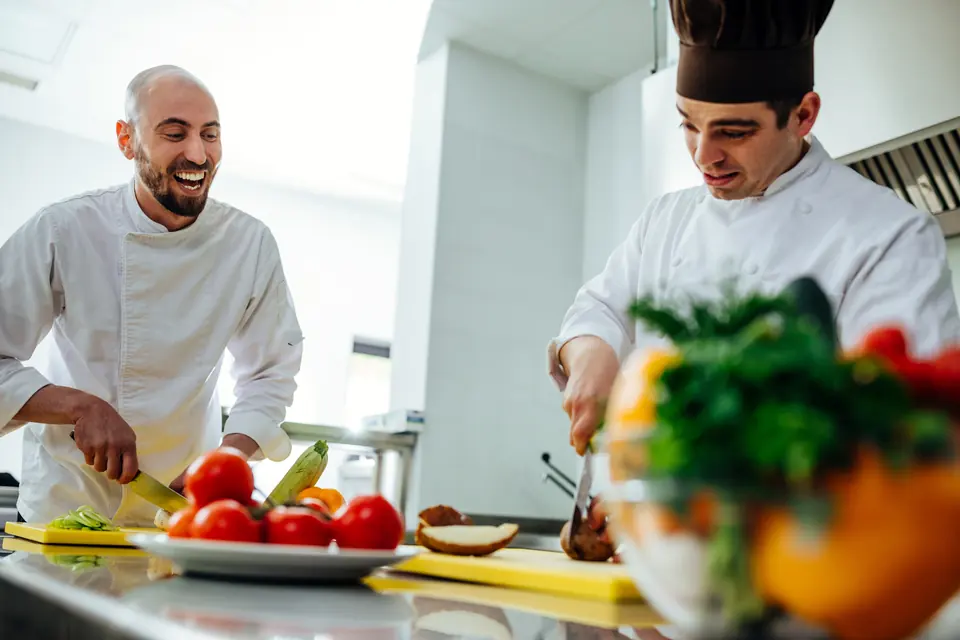
The provider cooks inside your plant, with its own staff, in a kitchen installed next to the cafeteria. Ingredients arrive raw, are stored there, and are prepared for each meal period.
It is the model that gives the most control over what is served and when. It also asks for the most: a room, gas, exhaust ventilation, water, drainage, refrigeration, a storeroom, and a dishwashing area.
Delivered meals
The food is prepared in the provider's central kitchen or commissary and travels to your plant ready to serve, in containers that hold temperature. At your facility you only need a service area with a serving line, tables, and a place to wash hands.
It starts fast and takes almost no investment. In exchange, there is a trip between the pot and the plate, and that trip is the point to watch.
Hybrid model
Part of the food is prepared in the commissary (stews, sauces, bases, desserts) and part is finished at your plant: tortillas, rice, griddle items, salads, final heating. It calls for a small finishing kitchen instead of a full kitchen.
It is the usual answer when there is some space, but not enough, or when the third shift has few people to serve and does not justify a full kitchen crew.
Comparison: where each model wins and loses
| Criterion | On-site kitchen | Delivered meals | Hybrid |
|---|---|---|---|
| Upfront investment | High: cooking equipment, refrigeration, exhaust ventilation, and utilities | Low: serving line and furniture | Medium: finishing and hot-holding equipment |
| Space required | Kitchen, storeroom, walk-in cooler, dishwashing, and dining area | Service area and dining area | Small finishing kitchen and dining area |
| Perceived quality | The highest: food is served freshly made and replenished during service | Depends on the dish; fried foods, pasta, and griddle items suffer in transit | Good if what does not travel well is finished on site |
| Food safety risk in transit | No prepared food is transported | The highest: temperature has to be held for the entire trip | Medium: only part of the menu travels |
| Flexibility by shift | High: food is cooked for each shift and adjusted on the fly | Low: the quantity is set before the food leaves the central kitchen | Medium: what is finished on site can be adjusted |
| Unplanned headcount | Covered with ingredients in the storeroom | Difficult: what did not travel does not exist | Partial |
| Utilities the plant provides | Gas, water, drainage, power, exhaust ventilation | Power and water for the service area | Somewhere in between |
Two notes on the table. The perceived quality column describes what is typical in the industry, not a rule: a brothy stew travels well and a breaded cutlet does not. And the investment depends on who supplies the equipment, which is negotiable. We explain it in how much an industrial cafeteria costs.
What the standard requires when food travels
The hygiene standard is the same for all three models. NOM-251-SSA1-2009 (Mexico's mandatory food hygiene standard) applies to anyone who processes food, and its chapter 7 covers food service establishments. Four points carry more weight when food is transported:
- Serving temperature. Ready-to-serve food must be held hot above 60 °C or cold at 7 °C or below (section 7.3.3). Delivered meals have to arrive and be served within those limits.
- An equipped serving line. Serving lines must have equipment to hold those temperatures (7.1.1). A table with covered trays does not comply.
- Reheating. If anything is reheated at your plant, it must reach at least 74 °C (7.3.2).
- Pests. Pest control covers food transport (5.10.1), and the plan must include the provider's own delivery vehicles (5.10.7).
Between the 7 °C and 60 °C that the standard sets as limits, food is unprotected. That is why transit is the weak point of the delivered model: every minute out of range counts.
The limits cited are temperature limits. The maximum time between leaving the central kitchen and service is best set in the contract, along with how it will be verified. For the details of the standard, see NOM-251 in an industrial cafeteria.
Criteria for deciding
There is no official headcount that marks the line between one model and another. What does exist are conditions that tip the balance.
An on-site kitchen suits you if:
- You have a room available, or you are building and can include it in the project.
- Your headcount is stable and large enough to support a kitchen crew every day.
- You run two or three shifts and want hot, freshly made food on each one.
- Your attendance changes on short notice: overtime, line stoppages, visitors.
- The cafeteria is a benefit that weighs on your employee retention.
Delivered meals suit you if:
- You have no space or utilities and do not plan to build them.
- Your workforce is small or the service is temporary: a plant startup, a construction project, a project lasting a few months.
- The provider's central kitchen is close and the route is predictable.
- Your headcount is known in advance and varies little.
- You need service soon, while you decide whether to invest in a kitchen.
The hybrid suits you if:
- You have a small area with power, water, and basic exhaust ventilation.
- You want to improve what arrives delivered today without building a full kitchen.
- You have one large shift and one small one: food is cooked on site for the first and reheated for the second.
If your plant is far from the city, distance counts twice: it raises the cost of the daily trip and increases the risk of food arriving out of temperature.
What changes in the contract
Equipment. With an on-site kitchen, put in writing who buys the equipment, who maintains it, and who owns it when the contract ends. With delivered meals, do the same for serving lines and containers.
Certifications. Distintivo H (a voluntary federal food-handling designation) is granted to an establishment with a specific address, not to the company, according to the scope published by SECTUR (Mexico's Ministry of Tourism). A provider can hold it for its commissary and not for the cafeteria at your plant, or the other way around. Ask for the certificate showing the address and the validity period.
Staff inside your plant. When the provider operates with its own people at your facility, it normally needs REPSE registration (Mexico's registry of specialized service providers): Article 15 of the Ley Federal del Trabajo (Federal Labor Law) requires anyone providing specialized services to register with the STPS (Mexico's Ministry of Labor).
Checklist before you sign
For an on-site kitchen:
- Floor plan of the area showing kitchen, storeroom, refrigeration, and dishwashing.
- Equipment list with the owner and the party responsible for maintenance.
- Kitchen crew per shift and who supervises it.
- Backup plan if gas, water, or power fails.
For delivered meals or a hybrid:
- Address of the central kitchen, and a visit before you sign.
- Type of container and vehicle, and whether the vehicle is in the pest control plan.
- Temperature log on leaving the kitchen and on arrival at your plant, with time and signature.
- Agreed maximum time between departure and service.
- What happens if food arrives out of temperature: who decides to reject it and what replaces it.
- Serving line with equipment to hold food hot and cold.
- Cutoff time to confirm the headcount for each shift.
How GAC keeps a consistent standard
Grupo Alimenticio del Carmen specializes in industrial cafeterias in San Luis Potosí. It works with the same ingredient suppliers in all its cafeterias, so the standard does not depend on the site.
Before proposing a model, the sensible step is to see the space. You can review the services and the quality and food safety section.
Frequently asked questions
Are delivered meals less safe than food cooked on site?
Not by definition. The hygiene standard is the same, and what changes is where the risk sits: in transit. If the provider holds hot food above 60 °C and cold food at 7 °C or below, and proves it with records, the model is valid.
How many people do I need to serve for an on-site kitchen to make sense?
There is no official figure. It depends on the shifts, the space, and who supplies the equipment. Ask two or three providers to quote both models with the same headcount and the same menu, and compare.
Can I start with delivered meals and move to an on-site kitchen later?
Yes, and it is a common path for new plants. It is worth writing it into the contract: on what date or under what condition the model changes, and how the price is adjusted.
Who supplies the kitchen equipment?
It is negotiable. The plant can supply it, the provider can, or it can be split. What must not be missing is a signed inventory stating who owns each piece of equipment and who pays for maintenance.
Does the hybrid cost more than delivered meals?
It calls for some equipment and staff on site, so it usually lands between the other two. The price depends on how much of the menu is finished at your plant; ask for the quote to break that out.
Next step
If you are torn between one model and another, a visit to your plant settles it: the space is measured, the utilities are reviewed, and the headcount per shift is counted. Ask us to walk your plant and receive a proposal with the model that fits your operation.